 |
| ALBERT HOENER POSTMASTER |
|
|
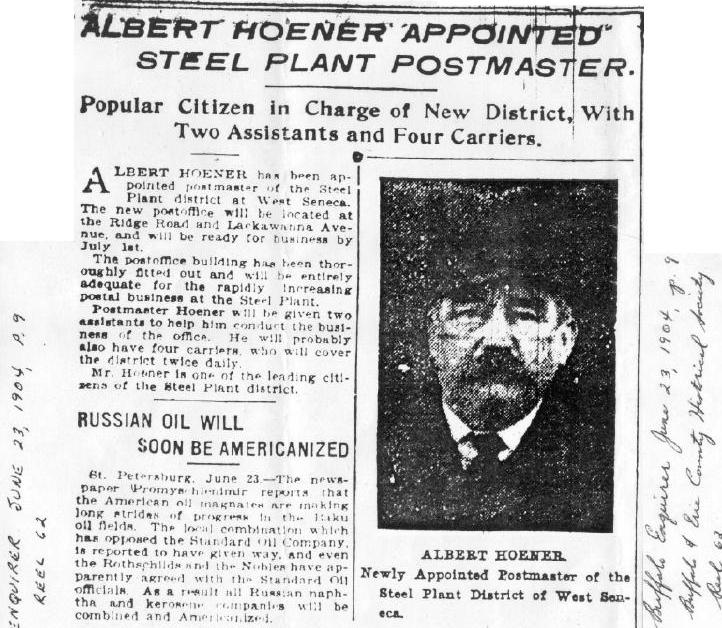
Albert Hoener Postmaster
Post Office Ridge Road Hoener Hotel Hoener Hotel Buffalo City Directory 1893
|
|
Wednesday Morning, March 6, 1895
HE WAS A BAD COLLECTOR Albert Hoener keeps a saloon on William Street, near Babcock Street. There may be those who think there is a pile of money in the saloon business, but Albert declares there is not. As an instance of this, he might tell the seeker after information on this subject that when he tried to collect a bill for $15 from one of his customers he was out $8 more after the attempt was over. It appears that John Lontkowaki has at various times visited Hoener's saloon, buying drinks, meals and tobacco. On many of these various occasions Hoener says that Lontkowaki? failed to pay, and at last the bill ran up to $15. Then Hoener thought it was time to give Lontkowaki a gentle reminder. Lontkowaki works for a railroad. On the 15th day of February there was joy in his house. the pay-car came that day and he would get his money. So he sstarted off happily to the paymaster. After he got his money he found his way blocked by Hoener, who wanted him to pay the bill. Hoener, apparently was not going to resort to any half-way measures. It is said that he told Mr. Lontkowaki that he would carry him into his saloon and make him pay the bill. Then he preceeded to carry out his threat, seizing Lontkowaki by the collar of his overcoat. Just then Mrs. Lontkowaki and a friend came to the aid of her husband. tehy hung onto his coattails and Hoener pulled awat at the collar. Something had to give. In this instance it was the collar. When Mr. Lontkowaki emerged from the conflict he found his coat in a sad condition. While he was surveying his dillapidated garment the saloon-keeper is said to have imparted information to him to the effect that he would catch him some other time and would make him pay. Mr. Lontkowaki swore vengeance. Never would he abide with the insult thus offered. Then, too, to look at that overcoat that a short time ago he had taken so much pride in it. But he would be cool and collected and not get his revenge by his own weak arms. He would call in the stronger limb of the law. The end of it all was yesterday, when both appeared before Judge Beannlein? in the Municipal Court. Mr. Lontkowaki came in with a smile on his face. At last he was going to get satisfaction. And he did too, for the Judge decided to give him a judgement of $8 for the price of the coat.
Thursday Morning, August 22, 1895
ONE BODY FOUND
WRECK HAS BEEN LOCATED. Of The Men Lost, All Were Employees At The Stock-Yards, Except One, Who Was a Switchman-The Body Found Was That Of Albert Stafford - The Stranger and the Fireman Have Been Reported Safe - Much Distress Caused By The Catastrophe - Capt. Whitewell Will Be Subjected To An Investigation. Investigation yesterday established the fact that of the 17 men aboard the ill-fated steam yacht Rung Brothers all but six are alive. Of the six who probably were drowned, the body of one was recovered yesterday. The Canadian who was supposed to have been on board when the boat foundered has reported himself alive and well. He is Harvey Stevens. He got off at Ferry Street with the four excursionists who went to the Wild West Show. He was carrying a message to inspector Clark from D. W. C. Hoover of Grand Island. The unknown fireman or deckhand who also was supposed to have gone down has been found. The Express learned that he is Simon Jardin of No. 60 Locust Street. He was one of the two rescued by two members of Capt. Williams's corps of life-savers who were grappling for Gillig's body when they saw the Rung Brothers borne down by it ike? big wave. With these accounted for, the list now stands as follows: Drowned - Albert Stafford, Frank Cannon, Frank Bugmann, Jacob Baumann, Charles Fischer, Henry Schindler. Saved - Capt. Edward Whitwell, Engineer, James Burley, Deckhand Simon Jardie, John Bugmann, Sebastian Bugmann, Albert Hoener. Got off at Ferry street- Harvey Stevens, John Kirss, Louis Roth, Edmund? Cook, Michael Maroney. Of the drowned men, all were employees at the stock-yards save one, who was a New York Central switchman, detailed about the stock-yards. Their ages, addresses, occupation and bereft relatives are as follows: Albert Stafford, in years old, sheep-sorter for Pfeiffer & Windsor Bros, commission merchants; unmarried; lived on Goemble Avenue near Walden Avenue; leaves a mother and father and brothers. Frank Cannon, 33 years old, chute-runner or stock agent for Errick? Bros,; lived at No. 6th? Howard Street; leaves a widowed mother, four brothers and two sisters. Two of his brothers, Charles and Lambert, are well-known commission merchants and the others, Joseph and Hugh, are employed by the New England Dressed Beef Company. Frank Bugmann, 51 years old, switchman for the New York Central lived at No. 79 Detroit Street; leaves a widow and six children. Jacob Bagmann, 31 years old, shipping clerk in the sheep-house; lived on Broadway near Goembel Avenue; leaves a widow and three children. Charles Fischer, 50? years old, worked for G. H. Hoover unloading stock from the cars at night; lived on William Street, near Fillmore Avenue; leaves a widow and two children. Henry Schindler, 21 years old, worked as butcher and sheep sorter for M. Kerr & Son; lived at No. 26 Ideal Street; unmarried; leaves a mother, father, a brother and three sisters. Further indentification of those who were saved and those who got off at Ferry Street is: Capt. Whitwell, No. 179 Swan Street; Engineer James Burley, No. 36 Illinois Street; Deckhand Simon Jardin, No. 60 Locust Street; John Bugmann, New York Central switchman at Stock-yards, No. 125 Cole Street; Sebastian Bugmann, saloon-keeper, No. 829 William Street; Albert Hoener, saloon-keeper, William Street, near Lewis; Harvey Stevens, Chippewa, Ont.; John Kless, switchman at the Stock-yards; Louis Roth, New York Central yardmaster at the Stock-yards; Samuel Cook and Michael Maroney, chute-runners. The foregoing is the first complete and correct list of thos who were aboard of the doomed yacht on it's trip up the river after leaving Buckhorn island. The one body that was recovered yesterday was that of Albert Stafford. It was brought to the surfact at 2:30 o'clock in the afternoon, after the police yacht, the life-saving crew, a wrecking crew and several email boats had been grappling for about nine hours at the scene of the catastrophe off the breakwater. The police boat which Supt. Ball/Bell? would not allow to go out on the night of the disaster, owing to the rough weather, started out as soon as day broke yesterday morning. She was manned by Acting-Capt. Pritchard, Pilot Warwick and Patrolman Hines and Tates. Seeking the wreck, they went out to a point near what is known to local mariners as the black stake. That was where the yacht was reported to have sunk. This proved to be fully a quarter of a mile out of the way. It was 11 o'clock when the wreck was located. The man who made the find was Bert Obers, an old naberman?, who was hired by the Barley brothers, owners of the Rung Brothers, to aid in the work of grappling. At this hour there were no less than a dozen small boats on the scene, beside the big surf-boat of the life-saving crew and the police yacht. Each boat had a grappler out for bodies or the wreck. Obera announced his ? to the others, and the police boat sloop was alongside, with its grapplars fast to the wreckage, so as not to lose it. Then the life-saving crew, under Capt. Williams p;aced a bouy over the spot where the boat lay, and grappling for bodies was begun in earnest. The water where the grounded boat rested was 10 feet deep. The top of the wreck was 15 feet under water. The Burley brothers seemed anxious to do all in their power to aid the relatives of the unfortunate to recover the bodies. They were on the scene from 7 o'clock in the morning until 9:30 o'clock last night, superintending and assisting in the work of exploring and raising the wreck. They have hired the wreching steamer, the Fern, of Algomac, Mich., and her outfit, to raise the boat. She went to work about an hour after the wreck was located and a couple of hours later her diver, Bert McMullen, brought up the body of Stafford. The body was lying close beside the hull of the sunken boat, having undoubtedly remained just where he went down. It was turned over to Supt. Pritchard, who took it to the dock at the foot of Genesee Street and sent for Coroner Kenney. On the arrival of the boat the crowd on the dock, composed of 200 or 300 people, including a dozen or 15 (illegible) relatives of the missing (illegible) pressed forward ca---ty to see the first recovered victims. The police kept the corpse covered with a canvas, and it was a (illegible) for the (illegible) and blood-smeared face and the chalk-white, shriveled hands were a sight to make men turn away. The body was all dressed except that the hat was missing. While the police were awaiting the Coroner's arrival, they allowed several who claimed to know the missing ones to view the body. They had no doubt, after a single glance, that the victim was Albert Stafford. Stafford's father identified him at the Morgue later and the body was sent home shortly afterward. On delivering the body over to the Coroner, the police boat returned to the scene of the wreck and continued grappling in that neighborhood for the remainder of the day. In the evening Capt. Pritchard and his crew were relieved by the night crew composed of Capt. (illegible), Engineer O'Conner and Patrolmen Kavany and Henafeldt, who continued the work with a vim that showed their sympathy with and willingness to aid the anxious relatives of the missing ones. (illegible) no more bodies were found by the diver or the grappling hooks of the police, the live-savers or the unofficial draggers. Among the last mentioned were near kinsmen of the missing men, whose tear-dimmed eyes and anxiety-stricken faces were touching to bdhold. With many a moan and a sob they drifted about on the, now-quiet waters, gazing intently at the depths beneath them and hoping that their sorrow would be at least modified by the finding of (illegible) that was left of the departed mortal. By 9:20 o'clock last night the Fern, aided by the police boat, had succeeded in partly raising the wrecked boat, and had hauled her from the spot where she sank, which was about 700 feet northeast of the second lighthouse and only 100 feet outside of the channel through which the excursion boats ply, to a point close to the inner side of the Government breakwater. There it was tied fast to the Fern, whose barge, with the wreck-raising derrick, will get the sunken yacht out of the water today if possible. Of course, the question of who or what was to blame for the sinking of the yacht was the subject of much discussion yesterday. The interesting feature of it all in that Capt. Whitwell contradicts the report which Engineer Burley and others who witnessed the sinking have given of the manner in which the foundering came about. The general assumption is that Whitwell turned the boat in the trough of the sea in such a way that she caught one of the largest? waves over her gunwales. Capt. Whitwell decalred to a reporter for The Express last evening that the turn had been completed and the boat was running straight ahead of the waves when the one struck her which swamped her. He says he did not take a quick turn but an easy, gradual one. Engineer Burley says the turn was too long. "Why," said he, "the sloan, which is no bigger than the Rung Brothers, came up afterwards and went up the river half a mile higher before making the turn; then, it made a quick turn and got around before the waves could catch her sideways, and she came in all right." Capt. Whitwell yesterday was directed by Inspector Galvin of the (illegible) house to make a written report of the affair. Whitwell did so and filed the report late in the afternoon. In it he states that the foundering was due purely to accident. He sticks to his original statement, that the steering apparatus was out of order, but admits that that was not the cause of the accident. He says the boat tripped herself up as many another has done. "It has happened many times farther out in the lake," he said to the reporter, "but this unfortunately happened close to shore." Capt. Whitwell seemed much disturbed over the misfortune which the disaster has wrought to the families of the missing. He ate hardly anything all day yesterday. He has had a run of very bad luck lately. His father was hurt in a runaway accident a few weeks ago, his brother was scalded to death on a tug-boat recently, and he himself was injured by a falling plate of steel in a ship-yard not long ago. And now comes this disaster, which has caused him not only great anxiety and physical discomfort, but which places his reputation as a pilot, his means of earning a livelihood and supporting his family, in question. Capt. Whitwell's report will be sent to the Supervising inspector at Washington forthwith, and as soon as a reply is received a public investigation of the whole affair will be begun. Either the Captain will be exonerated, or he will lose his license, and possibly be fined or imprisoned, for piloting human lives into danger. He expresed the conviction yesterday that he would be acquitted, but others have expressed the belief that the investigators will find it hard to justify his act in making the turn at such a time and place as he did. It would take columns to describe in detail the distress that is being suffered by the relatives of the drowned ones. Just this one case will serve as a basis for some idea of it. When a reporter for The Express called at the home of Henry Schindler on Ideal Street yesterday afternoon, he found the little girls playing about the yard. They were too young to appreciate the loss of their brother. When the visitor asked for their mother, they led the way to a bedroom. The shade was drawn and the room was dark and gloomy. All was silence, except for the sound of heavy breathing. Apparently the woman was sleeping, but when the shade was let up, the light streammed in upon sleepless, tear-stained eyes. The mother lay there beside a sleeping tot of 2 years, the youngest of her family of five, of whom the drowned boy was the oldenst. Her head was bandaged, as if she were suffering from a severe headache. When questioned, she replied by sign only. She was speechless from her overwrought condition. She was prostrated. From a neighbor it was learned that the family did not hear of the accident to the boat on which Henry had gone down the river until 6 o'clock yesterday morning. The father and mother could not believe the report. He hastened downtown and made inquiries. He returned in sorrowful silence, and the mother knew it was all too true. She swooned and when she revived she was so ill that she had to be put to bed, where she is likely to remain for some time. The neighbor said the drowning of the boy was a double blow to the family, inasmuch as he was the main support. The father, who is a tinsmith by trade, has had no work for a long time. The next oldest brother, Edward, has had only occasional employment at the stock-yards. Henry was bringing in about $? a week and on this the family were subsisting. Recently they undertook to buy the house in which they are now living. Only a small first payment has been made and now that the source of income has been taken away, the neighbor feared the family would not only have to abandon his home, but go to the Poor house. Charles Connors of No. 270 Metc?ife Street has offered a reward of $50 for the recovery of his brother's body. The stories of the survivors were repeated and listened to with interest yesterday. Among the noteworthy developments in this line is the story of Engineer James Burley, in which he frankly admits that he looked out only for himself while in the water, but earnestly eulogises a bit of heroism on the part of another of the survivors, namely ALBERT HOENER of William Street. Burley says he saw Hoener take a life preserver out from under his body and hand it to another man in the water who could not swim, saying: "Here, take it, I can swim." This man was saved, but HOENER was sinking, exhausted, when he finally reached the lifeline thrown to him.
1905
POSTMASTER HOENER'S IRE Post office officials have been working quietly on a project to add the town of West Seneca to the territory governed by the Buffalo office. The plan is not finished. It is said it provides for establishing a sub-station in the village of West Seneca. If the project is carried out, it will wipe out the West Seneca postoffice, and Postmaster Albert Hoener will lose his job. Naturally, Mr. Hoener is somewhat incesed over the matter. Some of the citizens of West Seneca also are opposed to the change, as they say it will mean delay of their mails. The village is badly in need of better postal facilities. It has a rural delivery service, which means one delivery a day. The rural carrier is not connected with the village postoffice. That office has no carriers, except that Mr. Hoener's boy delivers to the steel plant, such letters as are addressed to it direct. To a population of 15,000 there are only two mail boxes. One is at the corner of the Ridge road and South Park avenue, the other at the corner of the Ridge road and the Hamburg turnpike. The latter has been out of commission for some time. A wagon ran into and smashed it. About a month ago Postmaster Hoener wrote to the Postmaster General at Washington requesting additional facilities for his territory. He asked for four carriers and a dozen mail boxes. He has as yet received no reply, but a few days ago Postoffice Inspector Cochrane and two other Buffalo postoffice officials visited his office and talked of establishing a sub-station. The West Seneca postmaster is inclined to think someone is trying to job him. He says he has talked with citizens and has found they are against the changes. "The steel plant and a lot of other are against it." Mr. Hoener said yesterday, "It will mean a delay of twelve hours in the mails. All mail coming from the East or the West, which is addressed to West Seneca is dropped off the trains at the West Seneca station, brought at once to my office and is ready for the people as soon as they cal for it. If the city sub-station is adopted, all maill will have to go straight through to Buffalo and then come back to West Seneca. Also, anyone living in one part of West Seneca who writes to someone living in another part of West Seneca will have to wait for his answer until his letter has traveled to the city and back again. It would be a bad change for the town."
August 4, 1905
LAW IS COSTLY
Wednesday Evening, February 28, 1906, pg. 1
POSTMASTER ARRESTED Postoffice inspectors yesterday took charge of the office at West Seneca and began an examination of the accounts of Postmaster Hoener, who claimed to be robbed of $1,400 last week. His bondsmen will be obliged to make good.
Wednesday Evening, February 28, 1906, pg. 1
POSTMASTER ARRESTED Postoffice inspectors yesterday took charge of the office at West Seneca and began an examination of the accounts of Postmaster Hoener, who claimed to be robbed of $1,400 last week. His bondsmen will be obliged to make good.
Saturday Evening, March 17, 1906, pg. 8 Erie county grand jury yesterday reported an indictment against Albert Hoener, postmaster at West Seneca, recently arrested for embezzlement of postoffice funds.
November 10, 1906
HOENER TO FACE JURY Hoener has been indicted on a charge of misappropriating about $5,000 of the funds of the postoffice, while Nolan is charged with stealing money from registered letters. The case of Morris Sklorsky, who it is alleged made a false entry at Niagra Falls, will also come up for trial. Hoener's case will probably be the first one called.
Wednesday Morning, November 14, 1906
WEST SENECA POSTMASTER CHANGES HIS PLEA TO GUILTY Hoener was indicted by the grand jury of the district court, which convened at Lockport last October on a charge of embezzlement. The specific charge was that he had stolen $6,000 of the postoffice funds. By pleading guilty to the first count of the indictment it is understood that Hoener will escape trial on the other counts.
April 28, 1908, pg. 5
DISCHARGED FROM PRISON
1908
HOENER IS OUT
Saturday, August 7, 1909
NEAR RECORD IN FIFTY-MILE TRACK RACE AT BUFFALO As a preliminary to the big match race to-morrow between Barney Oldfield and Walter Christie, the two met to-day in a three-mile race. Christie drove his own car, while Oldfield was at the wheel of his new Benz racer. Christie won the race easily, the time for the three miles being 2:49. Two amateur drivers, entered in the five-mile handicap, free for all, had narrow escapes from death. At the three-quarters pole one of the drivers, Harry Hughes, cut the corner too closely and plunged through the fence. ALBERT HOENER, following, lost control of his machine and it went through the barrier on the opposite side of the track. Both machines were wrecked, but the men escaped with slight cuts and bruises about the hands and face. (NOTE: Article doesn't state if subject Albert Hoener is Albert Sr. b. 1851 or Albert Jr. b. 1890.]
|
|
BACK TO: HOENER
Updated April 17, 2013
|
